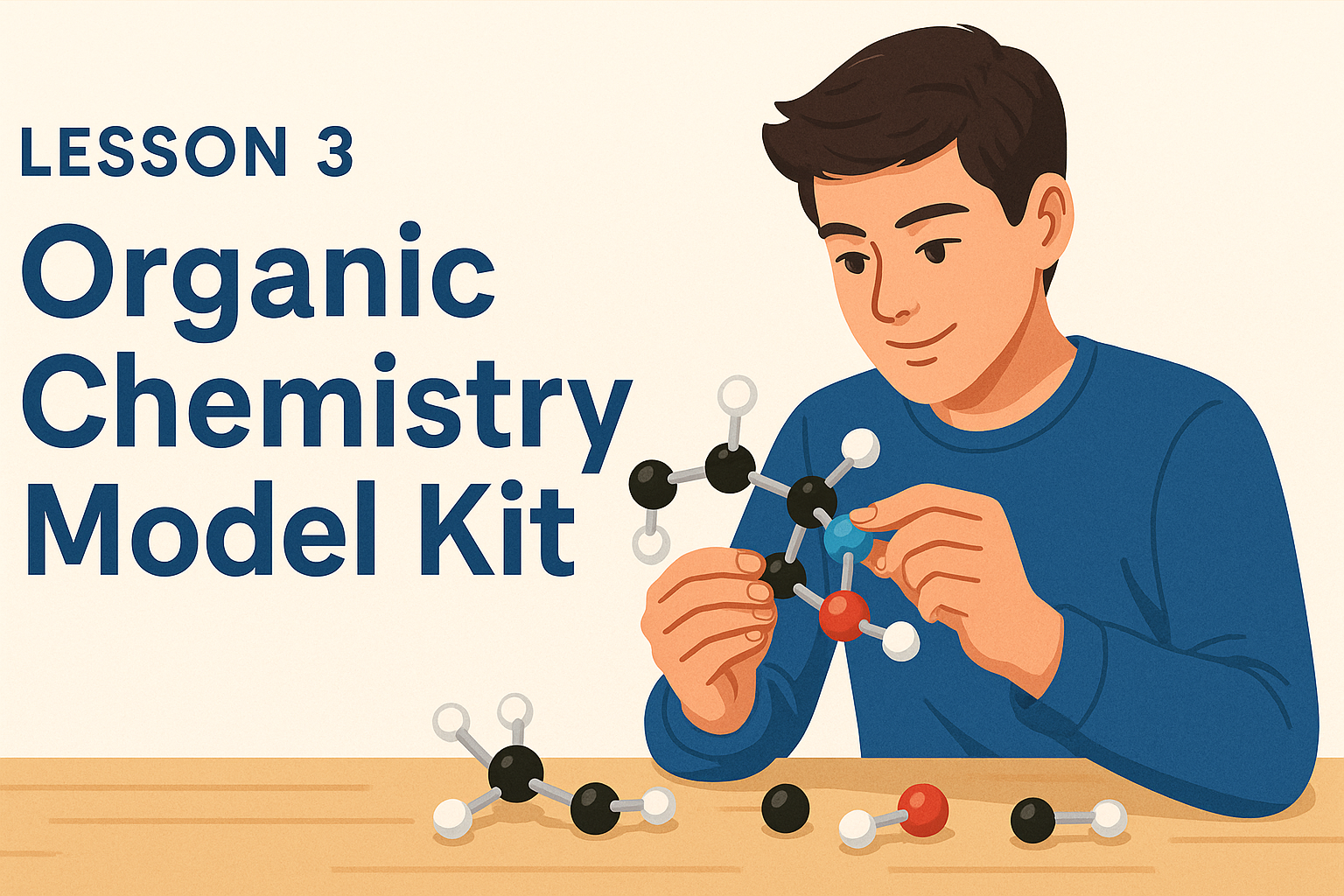
Lesson 3: Visualizing Molecules with the Old Nobby Organic Chemistry Model Kit
Build 3D molecules to understand shape, polarity, and isomers. Perfect for middle school through high school chemistry—or any visual learner.
Disclosure: This post contains affiliate links. As an Amazon Associate, we may earn from qualifying purchases at no extra cost to you.

Old Nobby Organic Chemistry Model Kit (425 pcs)
Hands-on molecular modeling for hybridization, VSEPR shapes, resonance, stereochemistry, and more—ideal for homeschool labs and unit reviews.
View on Amazon(Print-ready checklist + build prompts. Upload your PDF to this path or replace with Media Library URL.)
Learning Objectives
- Identify common molecular geometries (linear, trigonal planar, tetrahedral, trigonal pyramidal, bent).
- Relate electron domains/hybridization (sp, sp2, sp3) to 3D shapes.
- Distinguish structural vs. geometric isomers; introduce chirality (R/S) with models.
- Connect 3D shape to polarity and intermolecular forces at a conceptual level.
Materials Needed
- Old Nobby Organic Chemistry Model Kit (atoms, bonds, wedge/dash pieces)
- Printed build cards or prompt list (included in PDF)
- Notebook or lab sheet for sketches and reflections
Preparation & Setup (5–10 min)
- Sort atoms by color (C, H, O, N, halogens) and set out single/double bond connectors.
- Review VSEPR basics: electron domains → shape; define hybridization.
- Explain wedge/dash notation for 3D perspective and chirality.
Lesson Steps (35–50 min)
- Warm-Up (Shapes Quick Build): Build and label methane (CH4, tetrahedral), water (H2O, bent), ammonia (NH3, trigonal pyramidal), carbon dioxide (CO2, linear). Record bond angles.
- Hybridization Link: For each model, assign hybridization (CH4 → sp3, H2O → sp3, NH3 → sp3, CO2 → sp). Discuss how domains determine shape.
- Isomers Challenge: Build C2H6O in two ways (ethanol vs. dimethyl ether). Compare properties expected from structure.
- Geometric Isomers (Alkenes): Build 2-butene and show cis/trans. Discuss restricted rotation at double bonds.
- Intro to Chirality: Build lactic acid center model (or a simple four-different-substituent carbon). Create left/right hands and identify non-superimposability.
- Apply to Polarity: Decide if molecules are polar or nonpolar (e.g., CO2 nonpolar, H2O polar). Predict which has stronger intermolecular forces.
Discussion & Reflection
- How does 3D shape change the way molecules interact?
- Why can two molecules have the same formula but different properties?
- Where do you see chirality in everyday life (e.g., hands, certain medicines)?
Extensions & Cross-Subject Links
- Biology Link: Model amino acids; discuss protein folding and shape-function relationships.
- Math Link: Estimate bond angles; compare to ideal values (109.5°, 120°, 180°).
- Research: Pick a household molecule (citric acid, acetone, caffeine) and model its key features.
Parent & Teacher Tips
- Use phones to take photos of builds; add labels/arrows digitally for a study gallery.
- Have learners sketch each model—they remember better after drawing.
- Color-code notes to match atom colors for quick visual recall.
- Revisit models during later units (acids/bases, IMFs, organic reactions).
Wrap-Up
Physical models turn abstract chemistry into something you can hold. Building, rotating, and comparing structures develops real intuition about shape, polarity, and why molecules behave the way they do.
Disclosure: This article contains Amazon affiliate links. Purchases may support our site at no extra cost to you.