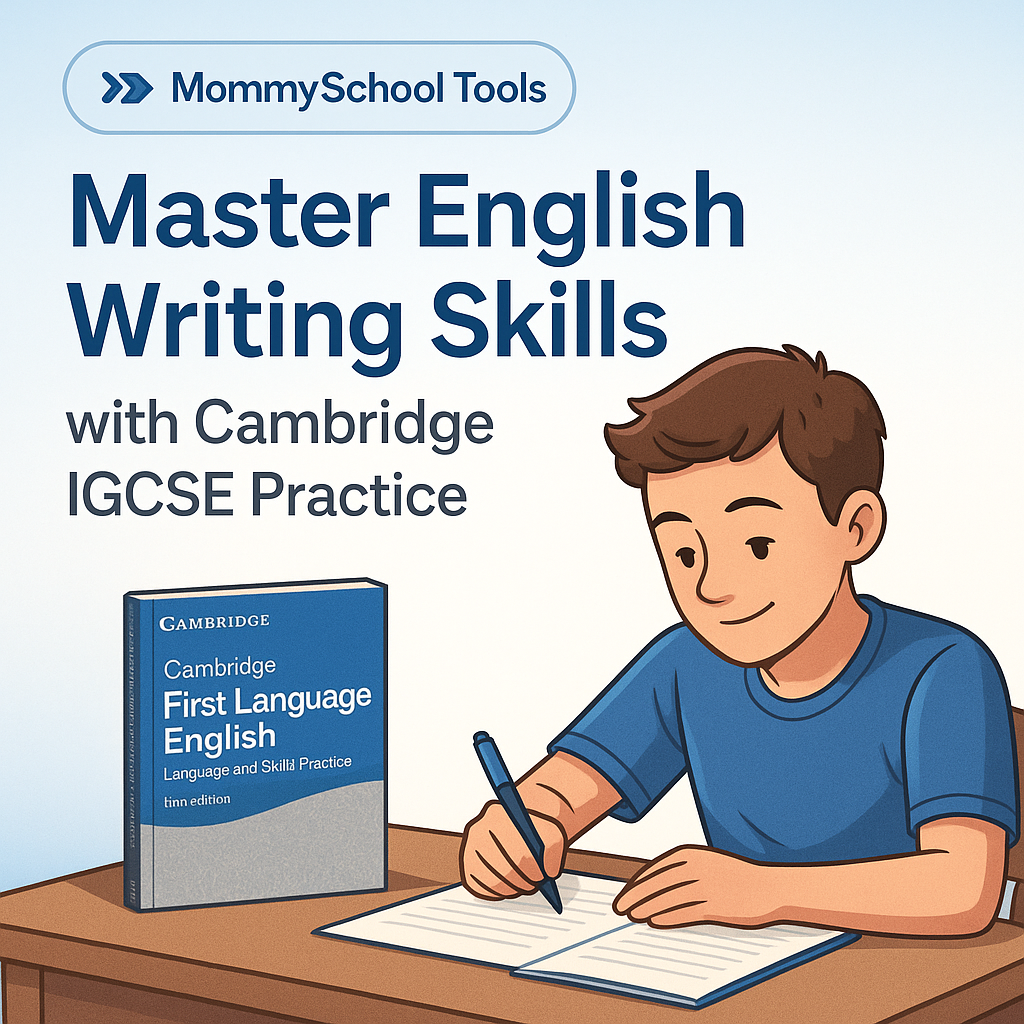
Master English Writing Skills with Cambridge IGCSE Practice
A structured, high-impact routine for response to reading, directed writing, summary, and composition—ideal for homeschool high school or exam-focused study.
Disclosure: This post contains affiliate links. As an Amazon Associate, we may earn from qualifying purchases at no extra cost to you.

Cambridge IGCSE® First Language English: Language & Skills Practice (5th Ed.)
Targeted practice for Paper 1/2 skills—close reading, writer’s effects, directed writing, summary, descriptive and narrative composition.
View on AmazonLearning Objectives
- Analyse language and structure to explain how writers create effects.
- Plan and write directed responses with clear audience, purpose, and tone.
- Summarise efficiently using selection, transformation, and concision.
- Craft descriptive/narrative compositions with control over imagery and paragraphing.
Materials
- Cambridge IGCSE® FLE Language & Skills Practice Book
- Timer (10–25 minute blocks), highlighters, notebook
- Optional: rubric printouts and vocabulary journal
5-Day Exam-Skills Cycle (30–45 minutes/day)
- Day 1 — Close Reading & Effects: Annotate a short passage. Identify 3–4 language choices; write bullet “effects” using device → effect → evidence.
- Day 2 — Directed Writing: Plan audience/purpose/tone. Draft 2–3 paragraphs that transform source material (no copying); check cohesion and register.
- Day 3 — Summary: Build a 10-point note grid from two paragraphs. Transform into a 120–150 word summary; remove examples, opinions, and repeats.
- Day 4 — Composition (Descriptive or Narrative): Plan a scene or plot path (S-C-Q-R-T). Draft 350–450 words; focus on controlled imagery and varied sentence openings.
- Day 5 — Edit & Rubric Score: Self-assess for AO-specific criteria (content, structure, style, accuracy). Redraft one paragraph for precision and flow.
Sentence frames: “The writer’s use of [device] suggests… which positions the reader to…” • “Adopting a [tone], I address [audience] by…”
High-Yield Mini-Routines (8–12 minutes)
- Effect Triads: Device → Quote → Effect (three lines max).
- Summary Surgery: Remove adjectives/adverbs; keep what happened only.
- Variety Drill: Rewrite one paragraph with 3 varied openings and 2 precise verbs.
Differentiation
- Support: Provide model paragraphs and highlight sentence stems; cap word counts.
- On-Level: Independent planning with checklist; peer swap for one “Glow/Grow.”
- Advanced: Integrate subtle tonal shifts; embed motifs; practise precision cutting to hit a tight word limit.
Assessment & Feedback
- Weekly timed piece (20–30 mins) rotated across skills.
- Rubric snapshot (Content/Style/Accuracy) → set one micro-target for next week.
- Vocabulary journal: 5 high-utility words/week used in a redraft.
Extensions & Enrichment
- Create a one-page “effects bank” (imagery, sound, sentence craft) with your best examples.
- Record a 60-second oral summary to practise concision and audience awareness.
- Compare two openings (news vs. memoir) to analyse purpose and register.
Includes weekly planner, rubric snapshot sheet, and mini-routine templates.
Tip: Keep practice short, frequent, and targeted. One tight paragraph improved daily outperforms occasional long drafts.