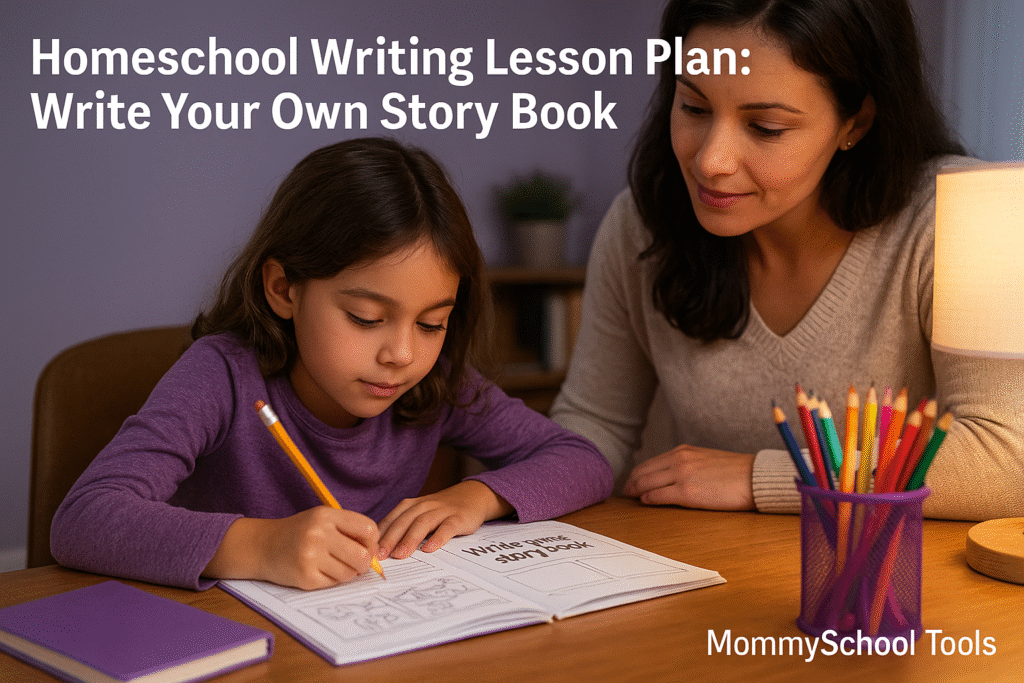
Lesson 1: Launch a Writer’s Workshop with Write Your Own Story Book
Kick off a joyful writing routine using prompts, comic strips, and guided pages that move kids from ideas → drafts → revisions → published pieces.
Disclosure: This post contains affiliate links. As an Amazon Associate, we may earn from qualifying purchases at no extra cost to you.

Write Your Own Story Book: Interactive Write-In Book
Built-in prompts, panels, and practice pages help reluctant writers get started and confident writers go deeper—with room for comic strips, journals, maps, and more.
View on AmazonLearning Objectives
- Generate ideas using picture prompts and sentence starters.
- Plan a beginning–middle–end using comic panels or story frames.
- Draft a short narrative with clear sentences and descriptive details.
- Revise using a kid-friendly checklist; publish a neat final page.
Materials
- Write Your Own Story Book (one per learner)
- Sharpened pencils, erasers, colored pencils
- Timer (10–15 min sprints)
- Optional: stickers for “published” pages; highlighters for revisions
Mini-Lesson (5–8 min): Small Moments Make Strong Stories
- Model: “Zoom in” on a single moment (e.g., finding a lost puppy) rather than “my whole weekend.”
- Think-aloud: jot quick notes for Beginning (Where? Who?), Middle (Problem/Action), End (Solution/Feeling).
- Show a sample page in the book: label panels B–M–E with 3–5 words each.
Sentence stems: “At first…”, “Then…”, “So I…”, “Finally…”, “I felt… because…”
Guided Practice (10–12 min)
- Choose a prompt page together (adventure, mystery, or everyday moment).
- Set a 5-minute timer: fill the B–M–E planner with words/sketches.
- Quick share: partner tells their plan using stems; partner asks one question to add a detail.
Independent Writing (15–20 min)
- Draft the story on the write-in pages. Circle one place to add a feeling word and one sound word.
- Revise with the checklist: capitals, end marks, spacing, vivid verb, one sensory detail.
- Publish: rewrite neatly or ink final panels; add a title and small illustration.
Differentiation
- Emerging writers: Dictate sentences to an adult, then trace. Use picture-only panels.
- On-level: Aim for 6–8 sentences; include time words (first/then/finally).
- Advanced: Add dialogue (quotation marks) and a second small problem before the solution.
Assessment & Reflection
- Quick rubric (1–4): Idea focus • Organization (B–M–E) • Conventions • Details/Voice.
- Exit ticket: “One revision I made was…” / “A detail that improved my story is…”
- Collect published page for a growing author portfolio.
Extensions
- Create a class anthology (scan final pages into a single PDF).
- Turn a story into a 4-panel comic; practice speech bubbles and sound effects.
- Record an audio read-aloud of the published story for family sharing.
Print-ready lesson with checklists, planner page, and rubric.
Note: Keep sessions short and positive. Consistency (10–20 minutes daily) grows writers faster than occasional long sessions.