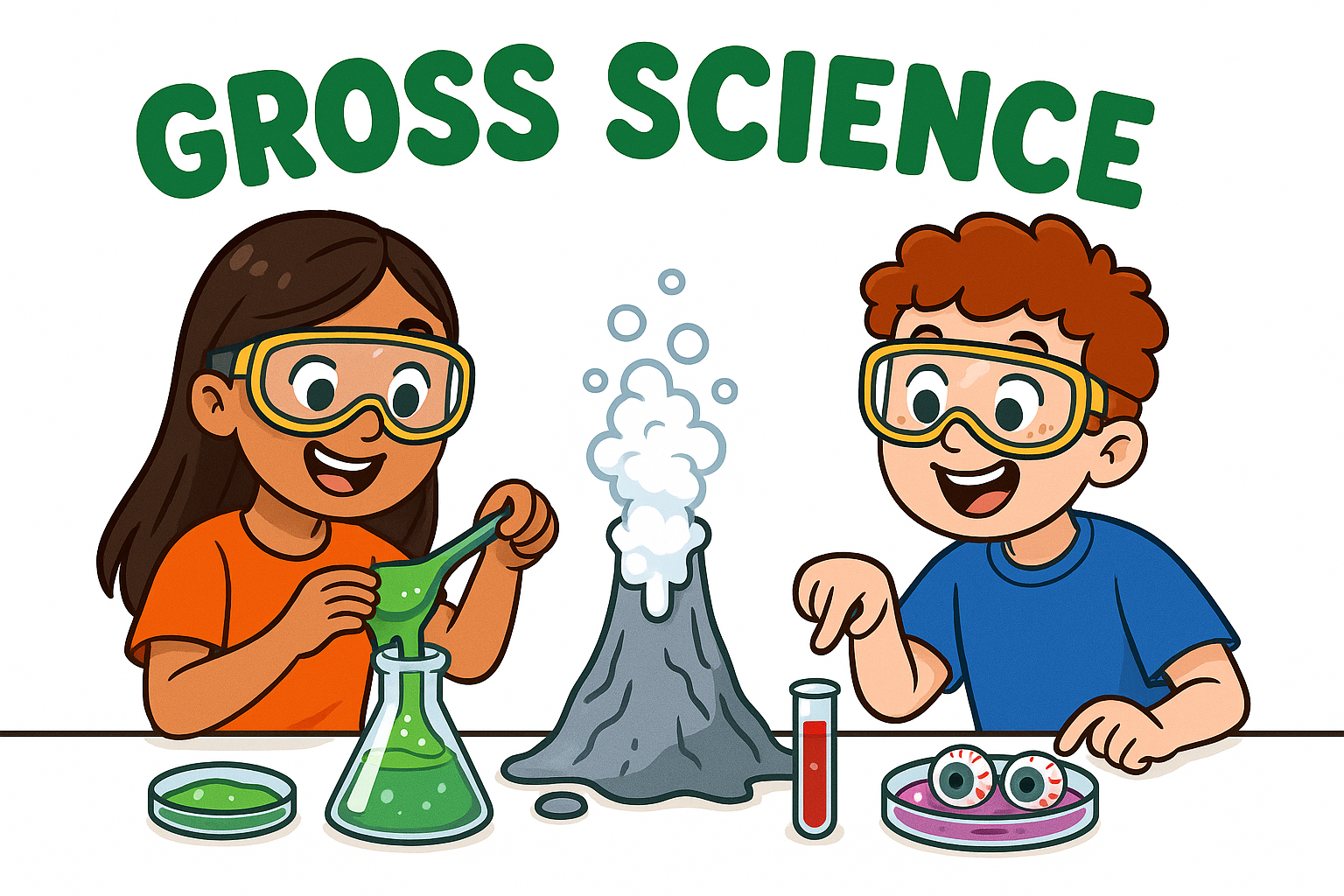
Lesson 6: Gross but Great Science — Exploring the Human Body with the National Geographic Gross Science Kit
Turn “eww” into “wow!” with hands-on experiments that teach kids about the human body, chemistry, and biology in the most memorable way possible — through safe, silly, and slimy science.
Disclosure: This post contains affiliate links. As an Amazon Associate, we may earn from qualifying purchases at no extra cost to you.

National Geographic Gross Science Kit
With over 45 experiments, students can dissect fake brains, make slime, and explore all things icky while learning about real biology and chemistry concepts safely.
View on Amazon(Print-ready homeschool version — includes experiment chart, vocabulary, and safety checklist.)
Learning Objectives
- Understand key biological systems and reactions through sensory learning.
- Develop curiosity about how the body works using tactile, kid-friendly experiments.
- Apply the scientific method: hypothesize, test, and record results.
- Encourage observation, discussion, and laughter while learning science safely.
Materials Needed
- National Geographic Gross Science Kit
- Disposable gloves and paper towels
- Plastic table cover or tray
- Notebook for observations
- Optional: magnifying glass or camera for close-up photos
Lesson Procedure
- Introduction: Discuss how our bodies produce interesting (and sometimes gross!) substances — like mucus, gas, or slime — and how they serve real functions.
- Experiment Choice: Pick 2–3 “gross” experiments — like making slime, fake mucus, or dissecting a model brain — and read the directions together.
- Observation: During each step, ask “What do you notice?” “What changes?” and “Why might that happen?”
- Data Collection: Record what happens to texture, color, and reaction time. Have learners describe the smells, shapes, and results with scientific vocabulary.
- Compare & Contrast: Which reactions were fast? Which were sticky or solid? Discuss what causes the differences.
- Reflection: Have learners explain one gross experiment and what real-life body process it models.
Discussion & Reflection
- What makes some body reactions helpful instead of just gross?
- Why is it important for scientists to study substances like mucus or bacteria?
- What did you learn about how different materials react together?
Extensions & Activities
- ELA Connection: Write a “Gross Science Report” using descriptive words for textures, smells, and reactions.
- STEM Challenge: Design your own “gross” experiment safely with everyday materials (gelatin, vinegar, baking soda).
- Art Integration: Draw a comic strip about your favorite gross science experiment or create a fun “Mad Scientist” poster.
Parent & Teacher Tips
- Encourage kids to use science language instead of “yuck!” when describing reactions.
- Discuss how “gross” experiments model real biological functions (e.g., digestion, mucus defense, chemical reactions).
- Use humor and curiosity — this type of experiment builds engagement and long-term memory.
- Take lots of photos! Documenting makes science feel more official and fun.
Wrap-Up
Gross science is memorable science. By exploring texture, smell, and reactions in a hands-on way, students turn curiosity into understanding — learning that biology and chemistry are all around us, even in the “gross” stuff!
Disclosure: This post includes affiliate links. Purchases support MommySchool Tools at no cost to you.