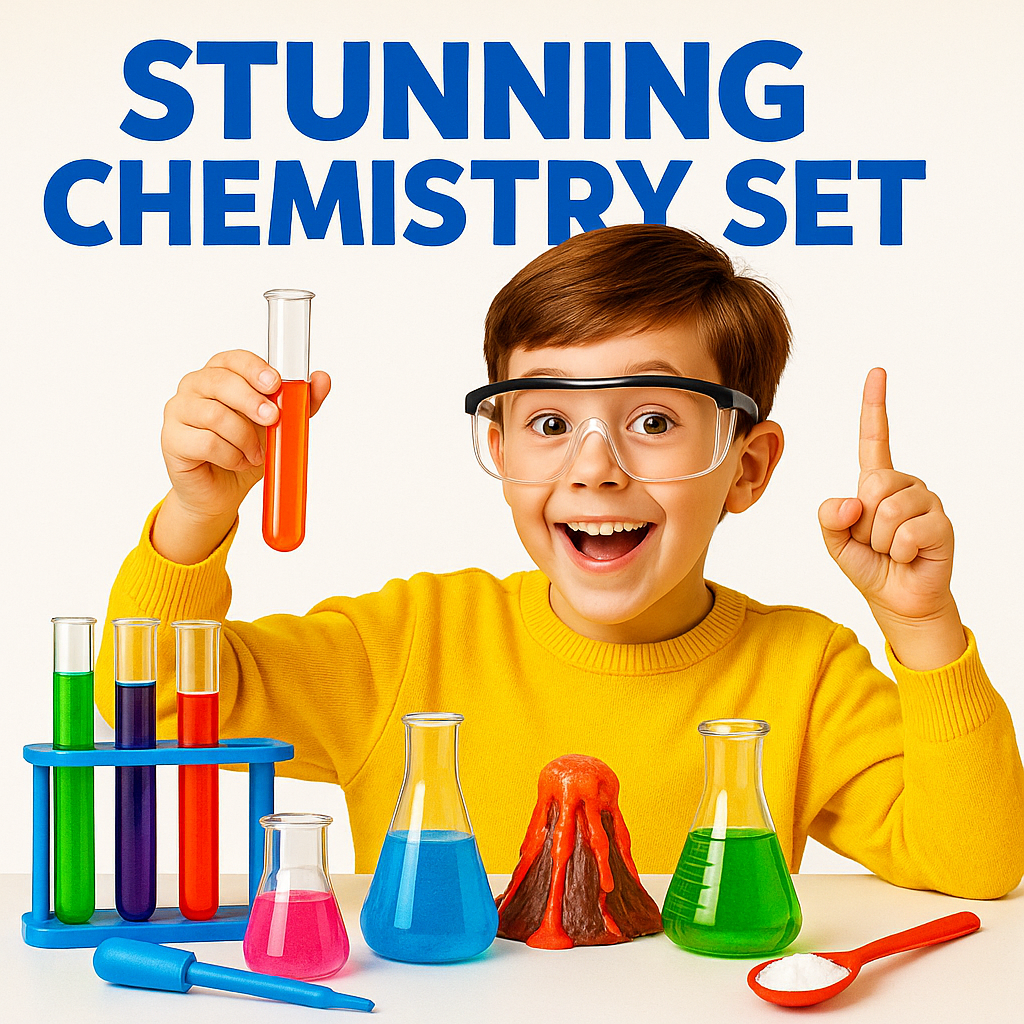
Lesson 5: Exploring Reactions with the National Geographic Stunning Chemistry Set
Introduce your learners to the amazing world of chemical change through safe, guided experiments that fizz, color, and bubble — igniting curiosity in every young scientist!
Disclosure: This post contains affiliate links. As an Amazon Associate, we may earn from qualifying purchases at no extra cost to you.

National Geographic Stunning Chemistry Set
Perform 45 easy and impressive experiments — from colorful reactions to erupting volcanoes and simple rockets — designed for hands-on STEM learning and excitement.
View on Amazon(Print-ready homeschool version — includes experiment log sheets and safety checklist.)
Learning Objectives
- Understand the difference between physical and chemical changes.
- Observe and describe visible evidence of reactions (bubbles, color change, temperature, gas formation).
- Practice safe lab habits and data recording.
- Develop critical thinking through predicting and observing outcomes.
Materials Needed
- National Geographic Stunning Chemistry Set
- Protective eyewear and gloves
- Notebook or lab sheet for data recording
- Optional: Thermometer, magnifier, or digital scale
Lesson Procedure
- Warm-Up: Discuss how scientists know a reaction has occurred. Show photos of rust, baking, or fireworks as real-world examples.
- Safety Setup: Review goggles, cleanup materials, and lab zone rules (no touching face, wash hands afterward).
- Reaction Time: Choose 2–3 experiments (bubbling volcano, rocket launch, color change). Have students predict the result and record what happens.
- Observation: Encourage learners to use precise descriptive language — “produced gas,” “temperature increased,” or “solution turned pink.”
- Compare & Contrast: Which experiments produced heat? Which only changed color? Discuss why.
- Cleanup: Safely dispose of materials and wipe the workspace clean.
Discussion & Reflection
- What clues helped you identify a chemical reaction?
- Which experiment was endothermic or exothermic?
- How do chemical reactions connect to things we see daily (cooking, photosynthesis, rust)?
Extensions
- Data Tracking: Graph which experiments had the fastest reaction time or most visible gas production.
- STEM Writing: Write a “reaction recipe” using ingredients, process, and results.
- Cross-Curricular: Connect to earth science (acid rain), biology (enzymes), or kitchen science (baking soda & vinegar).
Parent & Teacher Tips
- Encourage note-taking before and after — hypothesis vs. result.
- Focus on curiosity, not perfection — “Why did this happen?” is the goal.
- Repeat experiments with small variations (temperature, ratio, surface area).
- Always supervise; emphasize proper cleanup and safety habits.
Wrap-Up
Hands-on chemistry transforms abstract science into real, exciting learning. These activities teach observation, patience, and the joy of discovery — all while laying the foundation for future STEM success.
Disclosure: This post contains affiliate links. Purchases may support MommySchool Tools at no additional cost to you.