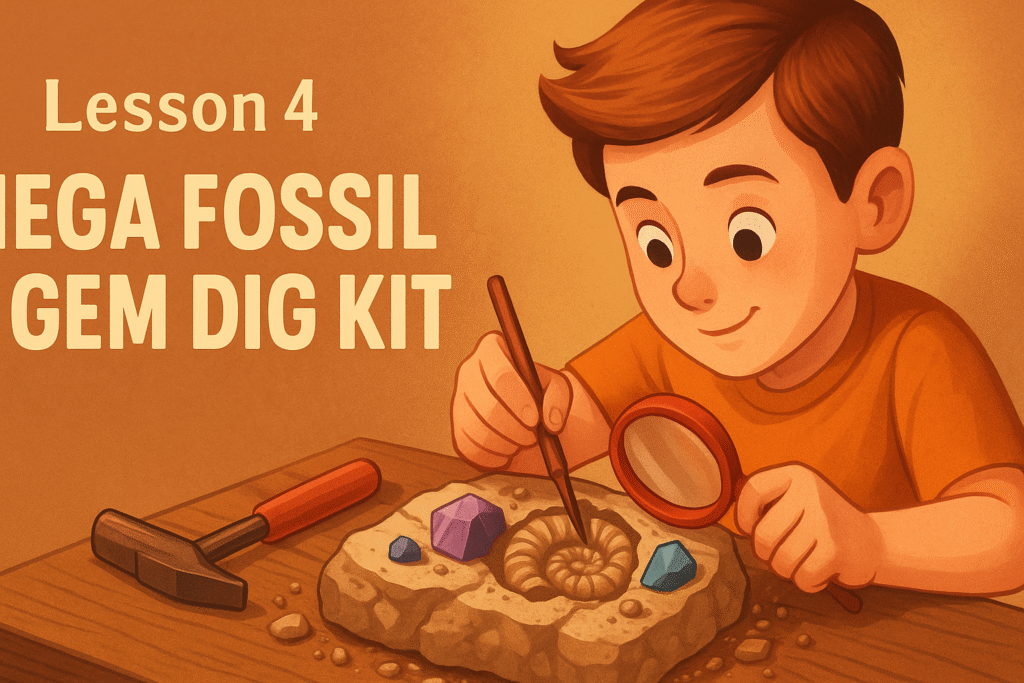
Lesson 4: Unearthing the Past with the National Geographic Mega Fossil & Gem Dig Kit
Excavate authentic fossils and gemstones, identify specimens, and build observational and classification skills—perfect for hands-on geology at home.
Disclosure: This post contains affiliate links. As an Amazon Associate, we may earn from qualifying purchases at no extra cost to you.

National Geographic Mega Fossil & Gemstone Dig Kit
Excavate 20 real fossils and gems with sturdy tools and an identification guide—an engaging entry point to paleontology and mineralogy.
View on Amazon(Print-ready homeschool version — observation charts, checklists, and specimen labels.)
Learning Objectives
- Practice safe excavation techniques and careful observation.
- Identify common fossils and gemstones using visual and text clues.
- Classify specimens by properties (hardness, luster, color, texture).
- Connect fossils and minerals to Earth’s history and rock cycle.
Materials Needed
- National Geographic Mega Fossil & Gemstone Dig Kit
- Shallow tray or newspaper for debris control
- Small bowl of water & paper towels
- Magnifying glass (optional) and a notebook
- Pencil, ruler (for size/scale notes)
Preparation & Setup (5–10 min)
- Skim the identification guide; pre-teach 3–5 vocabulary words (fossil, sediment, abrasion, luster, hardness).
- Set the dig block on a tray; place tools, water, and towels within reach.
- Model gentle scraping vs. chipping to avoid damaging a specimen.
Lesson Steps (35–60 min)
- Question Hook: “How do scientists figure out what life looked like long ago?” Brainstorm clues other than bones (imprints, trace fossils, amber, etc.).
- Excavation Round 1: Moisten the surface lightly. Scrape in thin layers until you expose the first specimen. Pause and predict: fossil or gem?
- Clean & Observe: Use a damp towel to remove dust. Note color, texture, size (use a ruler), and any visible patterns.
- Identify & Classify: Match to the guide. Record name, type (mineral/fossil), and 1–2 key properties. Sort finds into labeled cups or bags.
- Excavation Round 2: Continue carefully, rotating roles (excavator, recorder, photographer) if working in pairs.
- Share-Out: Lay out the collection “museum-style.” Learner explains how they identified each piece and what evidence supports the claim.
Observation & Data Table (suggested)
Have learners create a simple table in their notebook:
- Columns: Specimen # • Name • Type (Fossil/Gem) • Color • Texture/Luster • Size (mm) • Notes
- Optional: Add a Mohs hardness estimate for minerals using a paperclip/nail test (with supervision).
Discussion & Reflection
- Which features helped you tell fossils from minerals?
- What does your fossil collection suggest about ancient environments?
- How is a gem formed differently from a fossil?
- What questions would you ask a geologist about your finds?
Extensions & Cross-Subject Links
- Map It: Research where your fossil types are commonly found; mark on a world or state map.
- Rock Cycle Link: Place gems/minerals within the rock cycle (igneous/sedimentary/metamorphic).
- ELA: Write a museum placard for your favorite specimen (name, age, origin, interesting fact).
- Art: Sketch macro details you see with a magnifying glass (striations, crystal faces, inclusions).
Parent & Teacher Tips
- Lightly dampening the block reduces dust and speeds excavation.
- Rotate roles to build collaboration (excavator, brush/cleaner, recorder, identifier).
- Store finished finds in small zip bags with handwritten labels; keep a master index.
- Use accurate language (e.g., “specimen,” “matrix,” “sediment”) to build academic vocabulary.
Wrap-Up
By excavating, identifying, and classifying real specimens, learners practice the habits of earth scientists—observing carefully, gathering evidence, and telling a story about our planet’s past.
Disclosure: This article contains Amazon affiliate links. Purchases may support our site at no extra cost to you.