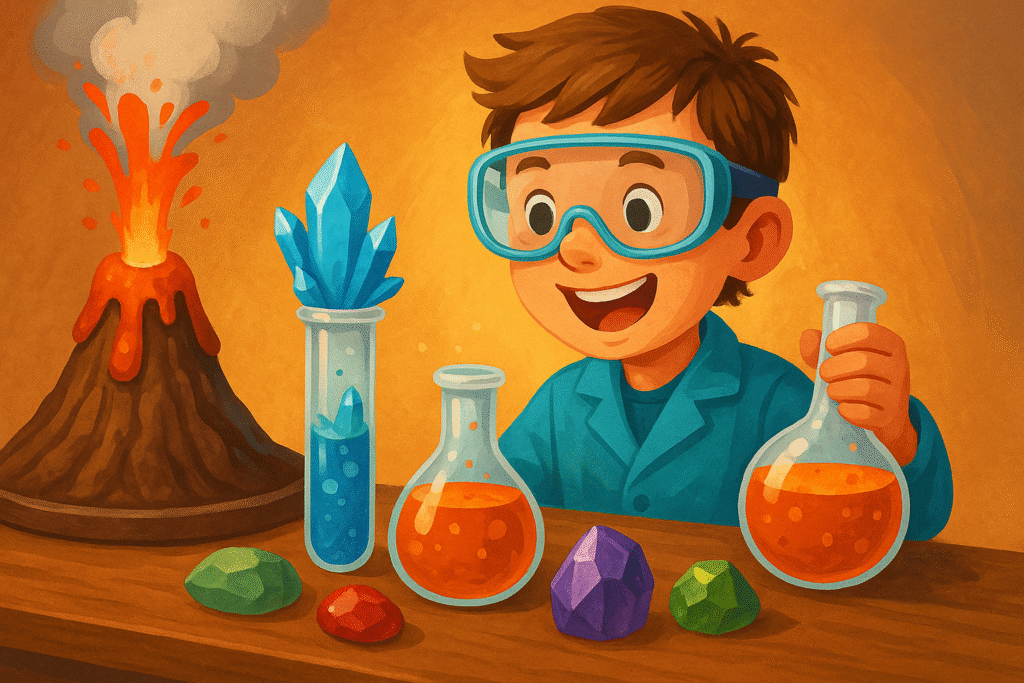
Lesson 2: Exploring Chemistry and Earth Science with the National Geographic STEM Science Kit
This all-in-one science kit combines crystal growing, volcano reactions, and gem digs to teach real-world chemistry and geology in a fun, hands-on way.
Disclosure: This post contains affiliate links. As an Amazon Associate, we may earn from qualifying purchases at no extra cost to you.

National Geographic STEM Science Kit
Includes over 15 guided experiments—grow crystals, erupt volcanoes, and dig up gemstones—all in one powerful STEM starter pack for homeschool families.
View on Amazon(Print-ready homeschool version — add notes, checklists, and progress tracking.)
Learning Objectives
- Understand basic chemical reactions (volcano eruption and crystal formation).
- Observe and record changes in matter during experiments.
- Explore how heat, saturation, and minerals affect crystal growth.
- Learn to follow procedures, collect data, and reflect on results.
Preparation & Setup
- Read through the included experiment guide to choose 2–3 projects for your lesson.
- Set up a clean, flat surface (tray or old newspaper) for each experiment.
- Have a timer, measuring cup, notebook, and phone camera ready.
- Discuss the concept of a “scientific variable” — what changes, what stays the same.
Activity: Volcano Eruption & Crystal Growth
- Intro Discussion: Ask your child what happens when baking soda meets vinegar. Show how this simple reaction models real chemical processes.
- Volcano Eruption: Build the volcano using the kit materials. Add vinegar and baking soda while observing bubbles and gas formation. Record your observations.
- Crystal Growth: Mix the crystal solution as directed. Pour into the provided dish and set it in a safe place to grow over several days. Record daily changes.
- Gem Dig: While waiting for crystals, dig up gemstones from the included block. Match each to the identification sheet.
- Wrap-Up: Compare your predictions to what actually happened. Why did crystals grow slowly while the volcano erupted quickly?
Reflection Questions
- What did you notice about how crystals formed over time?
- Why does mixing vinegar and baking soda cause fizzing?
- What could you change to make crystals grow larger or faster?
- How are real volcanoes similar or different from our experiment?
Extensions & Cross-Subject Links
- Math: Graph crystal growth height over several days.
- Language Arts: Write a “lab report” in complete sentences using key vocabulary.
- Geography: Locate volcanoes and mineral-rich regions on a world map.
- Art: Create a time-lapse collage of the growing crystals.
Parent & Teacher Tips
- Always supervise reactions — the fizzing and heat can surprise younger learners!
- Have students make hypotheses before each experiment: “What do you think will happen?”
- Use a magnifying glass to explore texture differences between crystals and rocks.
- Encourage patience: science takes time and observation is part of the discovery process.
Wrap-Up
This kit is one of the best all-around introductions to chemistry and geology. Kids experience chemical reactions, crystal growth, and excavation all in one set — perfect for multi-day homeschool lessons or STEM club rotations.
Disclosure: This article contains Amazon affiliate links. If you purchase through them, we may earn a small commission at no extra cost to you.